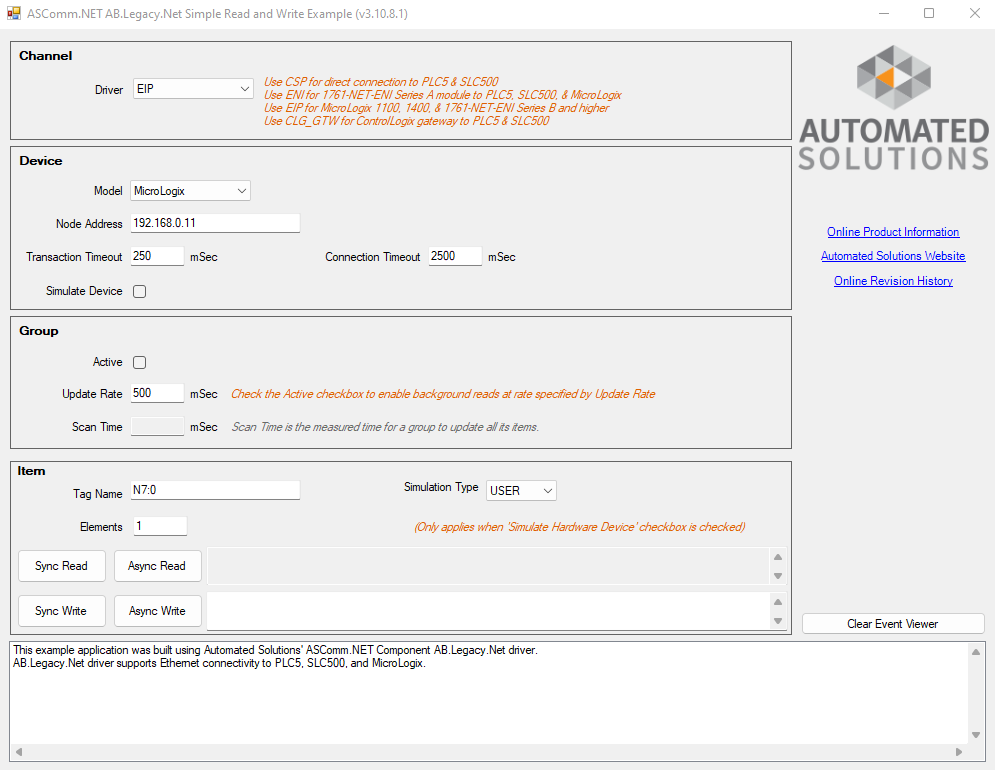
ASComm.NET Crack is a powerful and reliable .NET communication library for developers building industrial automation, HMI, SCADA, and data acquisition applications. With support for multiple PLC brands, native communication protocols, and seamless integration with Microsoft Visual Studio, it provides an efficient solution for connecting .NET applications to industrial devices without requiring OPC servers.
Whether you’re developing a new automation system or maintaining an existing one, ASComm.NET Free Trial offers the performance, flexibility, and documentation needed for professional industrial projects. Be sure to download the software from the official source, use a valid license, and keep it updated to benefit from the latest features, improvements, and security enhancements.
ASComm.NET Full PLC Driver Software Suite – Product Overview
ASComm.NET Full PLC Driver Software Suite is a comprehensive .NET Framework library designed for industrial automation and PLC communication. It provides developers with a complete set of high-performance drivers for connecting .NET applications to a wide range of PLCs using native communication protocols. Compatible with Visual Basic .NET, C#, C++, and ASP.NET, it is ideal for developing HMI, SCADA, industrial monitoring, and data logging solutions for Windows.
ASComm.net software download The development package includes detailed documentation along with ready-to-use sample projects in both C# and Visual Basic, helping developers integrate PLC communication into their applications quickly and efficiently.
Included PLC Drivers
The ASComm.NET Full Driver Suite supports communication with the following industrial devices:
- Allen-Bradley Logix Family: ControlLogix, CompactLogix, and GuardLogix controllers over Ethernet.
- Allen-Bradley Micro800 Series: Micro820 and Micro850 PLCs via Ethernet.
- Allen-Bradley Legacy Controllers: PLC-5, SLC 500, and MicroLogix families using Ethernet connectivity.
- GE SRTP Master: Ethernet communication for compatible GE PLCs.
- Siemens S7 Controllers: Supports S7-200, S7-300, S7-400, S7-1200, and S7-1500 PLCs over Ethernet.
- Modbus TCP Master: Enables communication with Modbus TCP devices across Ethernet networks.
- Modbus RTU & ASCII Master: Supports serial communication as well as encapsulated TCP/IP and UDP/IP connections.
Key Benefits
- ASComm Torrent Native PLC communication without requiring modifications to the PLC program.
- Read and write PLC registers directly from .NET applications.
- High-performance communication drivers for reliable industrial data exchange.
- Compatible with multiple Microsoft development environments.
- Includes complete C# and Visual Basic example applications with source code.
- Runtime-free deployment for qualified commercial applications, simplifying software distribution and reducing deployment costs.
Key Features
- Direct PLC communication using native industrial protocols
- Allen-Bradley / Rockwell Ethernet PLC Driver for .NET 10, 9, 8, 7, 6 HMI/SCADA
- No OPC server or additional drivers required
- Supports Visual Basic .NET, C#, C++, and ASP.NET
- Compatible with Visual Studio 2010–2022
- Works with .NET Framework 2.0–4.8
- Supports synchronous and asynchronous communication
- Multi-threaded architecture for high-performance applications
- ASComm.net Download Includes sample projects and comprehensive documentation
- Runtime-free deployment for qualifying commercial applications
Potential Uses
- .NET Framework 4.6.1 – 4.8 applications that run on Windows 11, 10, & Windows Server
- .NET 10.0, 9.0, 8.0, 7.0, & 6.0 applications that run on Windows 11, Linux, Android, and Mac
- Linux & Windows 10 IoT Core Apps that run on Rasberry Pi, MinnowBoard Turbot, Up Squared, NXP i.MX and other Linux / Windows IoT Core Devices
- Universal Windows Platform (UWP) applications that run on Windows 11
- MAUI applications that run on Windows, Android, and iOS (coming soon)
ASComm.NET vs ASComm IoT
| Feature | ASComm.NET | ASComm IoT |
|---|---|---|
| Framework | .NET Framework 2.0–4.8 | .NET 6–10 and .NET Standard |
| Operating Systems | Windows only | Windows, Linux, macOS, Android |
| Target Applications | Traditional HMI/SCADA | Cross-platform IIoT and modern .NET applications |
For new projects targeting modern .NET versions, Automated Solutions recommends ASComm IoT, while ASComm.NET remains suitable for existing Windows-based .NET Framework applications.

System Requirements
- Windows 7 SP1 or later (including Windows 10 and Windows 11)
- .NET Framework 2.0–4.8
- Microsoft Visual Studio
- Ethernet or serial connection to supported PLCs, depending on the driver used.
Supported Development Technologies
Developers can use:
- C#
- Visual Basic .NET
- C++/CLI
- ASP.NET
- Windows Forms
- WPF
- Console applications
- Windows Services
The library supports .NET Framework 2.0 through 4.8 and is intended for Windows applications. For modern .NET (6–10) and cross-platform development, Automated Solutions recommends ASComm IoT instead.
Industrial Drivers Available
Rather than being one single driver, ASComm.NET is available with multiple communication drivers, including:
- Allen-Bradley Logix (ControlLogix, CompactLogix, GuardLogix)
- Allen-Bradley Legacy (PLC-5, SLC-500, MicroLogix)
- Siemens S7
- GE SRTP
- Modbus TCP Client
- Modbus RTU/ASCII Master
Developers can purchase only the drivers they need.
Licensing
ASComm.NET is commercial software with several license models, including Machine Edition, Developer Edition, site licenses, and enterprise licenses. Automated Solutions also offers a fully functional 30-day evaluation version. The EULA prohibits unauthorized copying, reverse engineering, or redistribution outside the license terms.
ASComm.NET Installation and Setup
Setting up ASComm.NET involves installing the library, configuring your development environment, and establishing communication with your PLC or industrial device.
1. Download ASComm.NET
Download the latest version from the official Automated Solutions website. The installer includes the required libraries, documentation, sample applications, and licensing tools.
2. Install the Software
Run the installer with administrator privileges and follow the installation wizard. During installation, you can choose which communication drivers (such as Allen-Bradley, Siemens, or Modbus) to install.
3. Activate the License
After installation:
- Launch the License Manager (if required by your edition).
- Enter your purchased license key or use the evaluation license.
- Verify that the correct drivers are activated.
4. Create a New Project
Open Microsoft Visual Studio and create a new project using your preferred .NET Framework version (supported versions depend on the ASComm.NET release).
Typical project types include:
- Windows Forms
- WPF
- Console Application
- Windows Service
- ASP.NET Application
5. Add ASComm.NET References
Reference the required ASComm.NET DLLs in your project.
Typical steps:
- Right-click References
- Select Add Reference
- Browse to the ASComm.NET installation folder
- Add the required communication libraries
6. Configure PLC Communication
Before reading or writing PLC data, configure:
- PLC IP address
- Communication port
- Rack and slot (for supported PLCs)
- Communication timeout
- Polling interval
- Driver-specific parameters
7. Test the Connection
Use the included sample applications or write a simple test program to:
- Connect to the PLC
- Read a tag or register
- Write a test value (if appropriate)
- Disconnect cleanly
Successful communication confirms that your network settings and driver configuration are correct.
Performance Optimization
Industrial applications often require fast, reliable communication with minimal latency. The following practices can improve ASComm.NET performance.
Use Block Reads
Reading multiple values in a single request is generally more efficient than reading each tag individually.
Instead of:
- Read Tag1
- Read Tag2
- Read Tag3
Group compatible addresses into a single read operation whenever your PLC and protocol support it.
Reduce Polling Frequency
Polling too quickly increases network traffic and CPU usage.
Typical polling intervals:
- Critical control: 50–100 ms
- HMI displays: 250–500 ms
- Historical logging: 1–5 seconds
Choose the slowest interval that still meets your application’s requirements.
Use Asynchronous Communication
Asynchronous operations allow the user interface to remain responsive while communication occurs in the background.
Benefits include:
- Better UI responsiveness
- Improved scalability
- Higher throughput when monitoring multiple devices
Organize Tags Logically
Group related PLC variables together.
For example:
- Production counters
- Temperature sensors
- Motor status
- Alarm bits
Logical organization can simplify code and may reduce communication overhead.
Minimize Connection Overhead
Avoid repeatedly connecting and disconnecting from the PLC.
Instead:
- Open one connection
- Reuse it throughout the application
- Close it only when the application exits or communication is no longer needed
Optimize Network Configuration
For Ethernet communication:
- Use industrial-grade switches where appropriate.
- Prefer wired connections over Wi-Fi for PLC communication.
- Ensure PLC and PC are on the correct subnet (or that routing is properly configured).
- Avoid excessive broadcast traffic on the control network.
Avoid Unnecessary Writes
Only write values when they have actually changed. This reduces network traffic and unnecessary PLC processing.
Monitor Communication Statistics
Track metrics such as:
- Communication errors
- Retry counts
- Average response time
- Packet loss
- Connection uptime
Monitoring these values helps identify performance bottlenecks before they affect production.

Troubleshooting
When communication problems occur, a systematic approach can help identify the cause.
Cannot Connect to the PLC
Possible causes:
- Incorrect IP address
- Wrong communication driver
- Incorrect rack/slot configuration (where applicable)
- Firewall blocking communication
- PLC powered off
- Network cable disconnected
Check network connectivity using tools like ping (if supported by your network) and verify all communication parameters.
Read or Write Operations Fail
Possible reasons include:
- Invalid tag or register address
- Insufficient PLC permissions
- Incorrect data type
- Communication timeout
- PLC in a restricted operating mode
Verify the address and data type against the PLC program.
Slow Communication
Potential causes:
- Polling too frequently
- Reading too many individual tags
- Network congestion
- High PLC CPU utilization
- Excessive simultaneous client connections
Grouping reads, increasing polling intervals, and reducing unnecessary requests can often improve performance.
Random Disconnects
Intermittent communication may result from:
- Faulty Ethernet cables
- Unstable network hardware
- Duplicate IP addresses
- PLC reboots
- Power interruptions
- Firewall or antivirus interference
Review network logs and ensure all devices have stable power and unique IP addresses.
Licensing Issues
If the software reports licensing errors:
- Confirm the license is activated.
- Verify that the installed driver matches your license.
- Ensure the evaluation period has not expired.
- Check whether your license is tied to specific hardware.
If problems persist, contact Automated Solutions support with your license details.
Best Practices for Reliable Operation
- Keep regular backups of your project and PLC program.
- Test changes in a development environment before deploying to production.
- Log communication errors for later analysis.
- Use appropriate timeout and retry values for your network.
- Keep Windows, Visual Studio, and ASComm.net Software Torrent updated with supported releases.
- Follow the documentation for the specific PLC protocol and driver you are using.
These practices help improve reliability, simplify maintenance, and reduce downtime in industrial automation applications.
Conclusion
ASComm.NET Free Download is a commercial .NET communication library developed by Automated Solutions for building industrial automation applications. It enables .NET applications to communicate directly with PLCs (Programmable Logic Controllers), PACs, and industrial devices using native protocols—without requiring OPC servers or third-party drivers.
This was beautiful Admin. Thank you for your reflections.